13 April 2026
How to Make a Problem Disappear
Day 11 of Inkhaven: 30 Days of Posts
In yesterday's post I looked at how private solar production was mostly responsible for solving load shedding. Today we look at the issue of how electricity is used by municipal governments to cover budgetary shortfalls which leads to the slow accumulation of Eskom's debt.
The Ever Renewing Revenue Source
Eskom sells electricity at a bulk price to municipalities who then sell it on to their constituents, typically for a higher price. Many municipalities do not pay Eskom for this electricity, or pay partially, saddling Eskom with debt. Municipal debt to Eskom stands at R62 billion and is projected to reach R358 billion by 2031. They can do this because Eskom will eventually be bailed out by the national government using tax money. In the meantime the electricity is used to generate revenue for the municipalities through sale to people using and paying for the electricity and disappears in the form of corruption or other shortfalls in budget.
Eskom can't cut them off because the people within the municipalities include critical infrastructure such as hospitals and airports. The municipality is effectively holding them hostage as a way to keep running, when by default they should have just been cut off.
As a case study, Ekurhuleni, which includes OR Tambo International Airport, saw its debt to Eskom grow from R544 million to R3.4 billion from 2022 to 2026, while its residents continued paying their electricity bills. In a particularly damning move, in 2025 the ANC-EFF-ActionSA coalition government there paid extensive bonuses to the city manager and other top officials while debt to Eskom was at R2.3 billion.
Eskom proposed selling electricity directly to customers at its own tariff, which is considerably lower than what the municipality charges, but the municipality resisted, because direct billing would expose that they depend on skimming the electricity provided by Eskom for their revenue. Eskom can't simply cut them off because OR Tambo airport receives its power through the metro, and it would be catastrophic for it to be without power. So instead, another payment plan was agreed upon. So far Ekurhuleni has broken every previous agreement.
The death spiral
This means that Eskom are forced to raise prices in order to make up shortfalls in revenue elsewhere. Eskom's average residential price went from R1.08/kWh in 2016 to R2.53/kWh in 2025, a 134% increase, with further hikes of 8.76% and 8.83% coming in 2026 and 2027. The scarcity of paying customers has been exacerbated by the fact that solar power is now in fact less than half the price of buying power from Eskom, around 30-40% of the standard grid tariff.
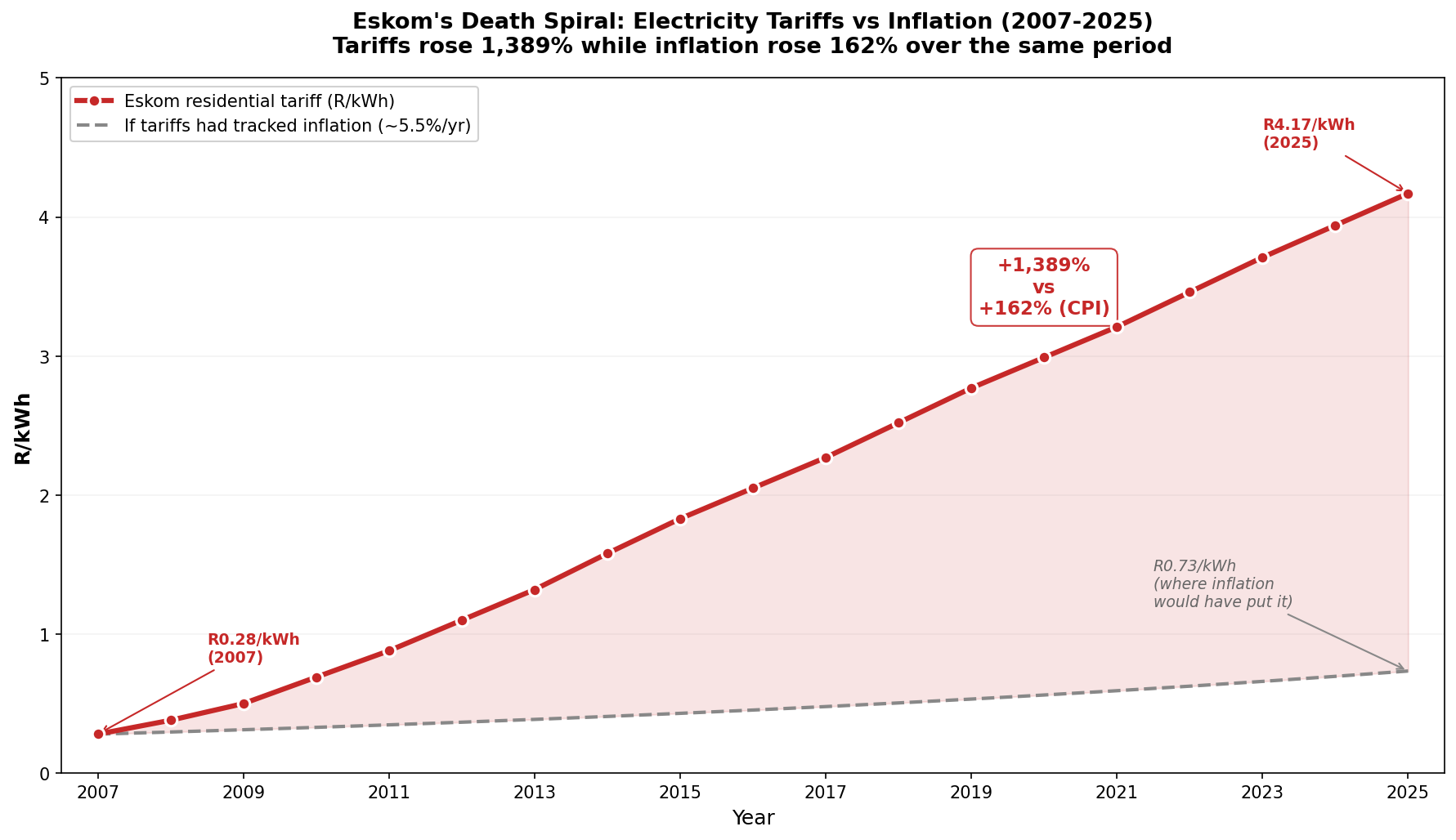
This means that for those who have the capital to buy solar panels upfront, they have already done so or will do so soon. It takes 3 years to pay off the panels at the current cost, meaning that it's a no brainer. This leads to a death spiral where the industrial consumers or those wealthy enough to leave the grid shrink the revenue pool even further, leading to further price hikes and more incentive to leave. Eskom's sales volumes dropped 11.5% between 2016 and 2025, while revenue more than doubled, entirely through price increases.
The massive uptake in solar power during the load shedding crisis accelerated this even further. In a sense unleashing private generators has opened Pandora's box for Eskom, and now it is very hard to return to how things were.
Who pays for this?
Ultimately Eskom are in a double bind where the people who can leave them, do, and the people who can't leave them won't actually pay them. 13.2 million South Africans live in extreme poverty. A residential solar system costs R70,000-350,000. For someone living on R34 a day, the economics that make solar a no-brainer for businesses are completely irrelevant. The problem is left to silently and recurrently be solved through bailouts, while failing municipalities keep the lights on at the expense of national taxpayer money.
The best solution for this would be a government subsidised drive to provide capital for low income folks to be able to access solar power, while also setting a higher base fee for grid access. Some companies already provide a great service of upfronting the capital for solar panels and accepting a fee on the power they provide which is cheaper than Eskom, so they can profit from the longer timescale. These programs are worth supporting while making sure they don't bankrupt Eskom (further).
It's worth noting that this pattern is far from unique among developing economies, particularly in countries where a single entity has a monopoly on electricity production. India and Pakistan have similar arrangements with intermediaries selling power without paying for it. What makes South Africa unique is how the introduction of rapid private solar might accelerate the squeezing of revenue providers ever smaller.
Leave a comment
Comments are public and appear once reviewed. No email address is collected.
Questions, thoughts?
No comments yet. Be the first to leave one below.