13 April 2026
How South Africa's Electricity Catastrophe Was (Mostly) Fixed
Day 10 of Inkhaven: 30 Days of Posts
South Africa is famous for having catastrophic electrical infrastructure failure, which is characterised by rolling blackouts that we have named "load shedding". This refers to cyclically diverting power from certain areas to avoid complete grid collapse. During 2023, load shedding occurred for 332 days of the year with varying severity sometimes getting so bad that for 12+ hours a day, one would be completely without power.
In many ways, this situation has improved significantly, with power being available a great deal of the time. Load shedding has barely occurred in the last year. Interestingly, the reasons for this are not due to Eskom, the state electricity provider, bravely stepping up to the plate and adding generation capacity to the system but rather because private entities installed sufficient amounts of their own electrical capacity, primarily in the form of solar power, that demand on the grid dropped enough to avoid further blackouts. Notably, according to OECD data, 71% of this private capacity was commercial and industrial, 17% agricultural, and only 12% residential. This was not primarily a story of wealthy homeowners putting panels on their roofs, it was businesses that switched because they needed power to keep operating.
How did it get so bad?
The infrastructure that democratic South Africa inherited was primarily built to serve white South Africans during apartheid. After the advent of democracy in 1994, the infrastructure was rapidly expanded to serve a much larger population. This was a great humanitarian story, rapidly providing electricity to additional millions of people in South Africa who had previously been largely excluded from the benefits of modernisation. Unfortunately the additional generation capacity in the form of power plants was not kicked off at the same time. Most of the supply used the surplus capacity from the existing infrastructure.
In 1998, Eskom's own analysts and the Department of Minerals and Energy warned the ANC government led by Thabo Mbeki that reserves would run out by 2007. But Mbeki's government was considering privatising Eskom, and building new state generation capacity would have undermined that plan. Permission to expand was denied until 2004, by which point it was too late. In 2007, Mbeki admitted it publicly, saying "We were wrong. Eskom was right."
Up until recently there was a regulatory framework in place that made it so that private electricity providers needed a license to generate more than 1MW of power until the limit was raised to 100MW in 2021, and finally lifted completely in 2022, right around when load shedding became truly desperate. As we'll see this led to a huge surge in private solar capacity coming online.
How load shedding got fixed
Private solar deployment between 2022 and 2025 added an estimated 4.9 GW of capacity at an estimated total cost of around R105 billion. For context, the apartheid government commissioned 35,804 MW between 1961 and 1996. In the entire post-apartheid era, Eskom has added just 9,564 MW, primarily through the Medupi (R234 billion) and Kusile (R118 billion) coal power plants, whose combined cost as estimated by independent evaluations was R352 billion. The Medupi and Kusile projects were plagued by massive delays, design defects, and a R139 billion corruption investigation by the Special Investigating Unit.
To compare with some back of the napkin calculations, private solar came in at roughly R14-33Million per MW, while new Eskom coal power cost between R37-51 Million per MW.
While these numbers are quite hard to pin down, by any reasonable estimate the rate at which private interests were able to deploy power to the system was remarkable. In a 3 year period they were able to deploy half as much capacity as Eskom had done in the entire 21st century, for less than a third of the total cost (R105 billion vs R352 billion).
The Energy Availability Factor or EAF represents the amount of grid capacity that could be deployed by Eskom at a given time. As you can see in the figure below, during the main crisis period EAF stayed relatively flat, with improvements beginning around June 2024. The rapid solar deployment clearly leads to a gradual winding down as supply outpaced demand, finally leading to the end of load shedding in around April 2024.
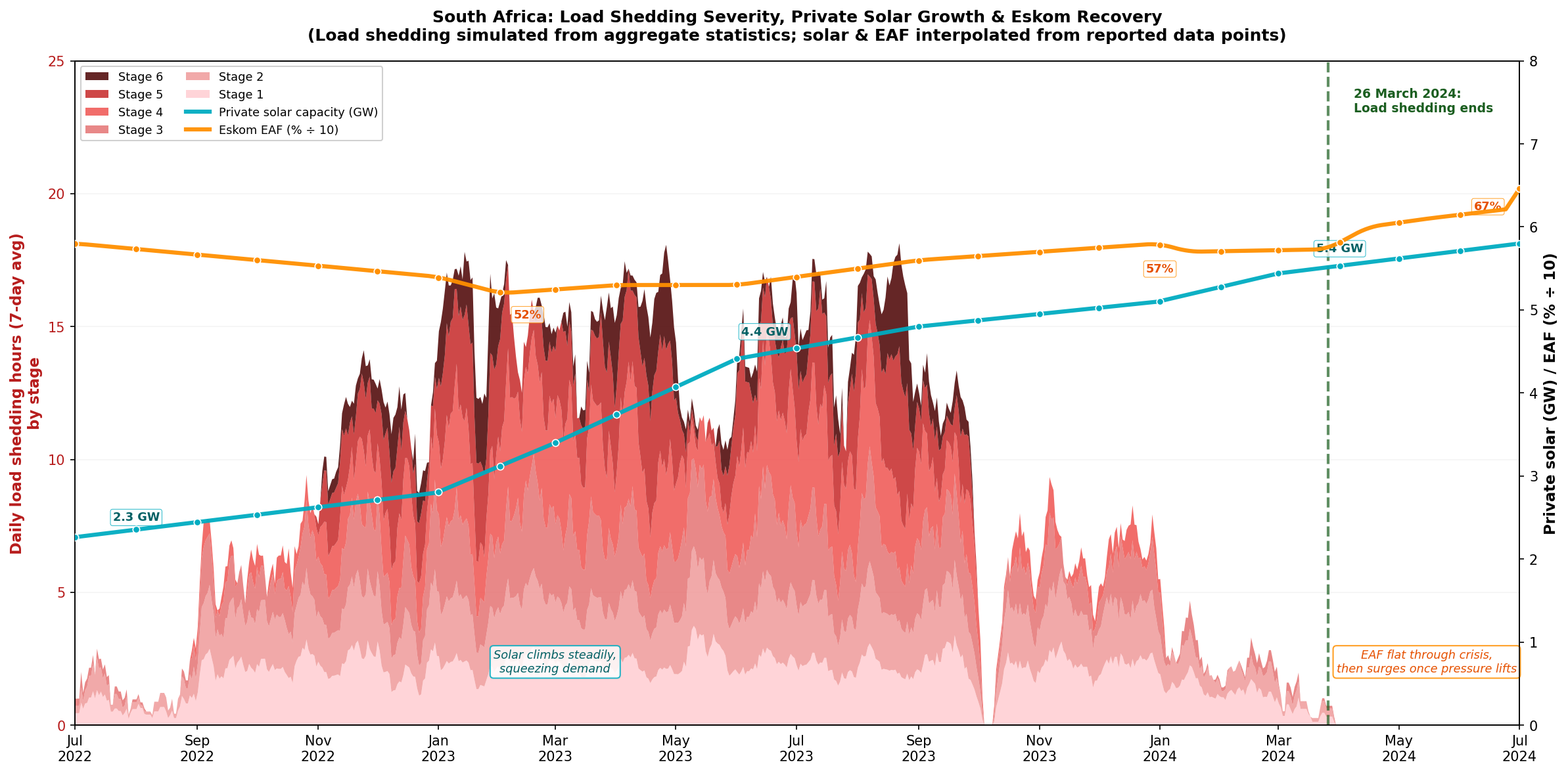
Initially when looking at the data, I was confused as to how load shedding ended so suddenly. The graph above shows the daily severity of load shedding, factoring in both the stage and duration throughout each day. What becomes clear is that even a modest increase in available capacity led to a significant drop in daily load shedding, because the additional solar sits on top of an already large base of grid capacity. The system operates on a knife edge where load shedding is triggered whenever demand exceeds supply by any margin, so small shifts in either direction produce outsized effects. The same dynamic that caused load shedding to escalate so rapidly also explains why it stopped so abruptly.
Concluding thoughts
This is quite a remarkable and encouraging story on its own, but it still leaves the question open of whether the electrical problems of the country are over. The fact that private producers are now free to add and sell power gives me hope for the future, because unshackling them was essential to solving the problem. As a result, the system has greater ability to adapt and fix itself even if generation collapses on the Eskom side, though if too much goes offline too quickly then load shedding could return while they adapt.
However, the problem of why Eskom is so unable to make progress here hasn't been answered. Trying to understand this question provided some fascinating insights into some of the core dysfunctions in South Africa's governance today.
In Part 2, I'll explore how this leads to an enormous challenge for Eskom.
Leave a comment
Comments are public and appear once reviewed. No email address is collected.
Questions, thoughts?
No comments yet. Be the first to leave one below.