1 May 2026
Why Are Anglophone Countries Unhappier Than Their European Counterparts?
Day 26 of Inkhaven: 30 Days of Posts
Recently I stumbled across some surprising research showing that in general happiness is staying flat or rising in most of the world, except in English speaking countries, where youth happiness has fallen significantly relative to 2005-2010. The actual drop on a 0-10 scale in NANZ countries (NANZ = The United States, Canada, Australia, and New Zealand) has been 0.86.
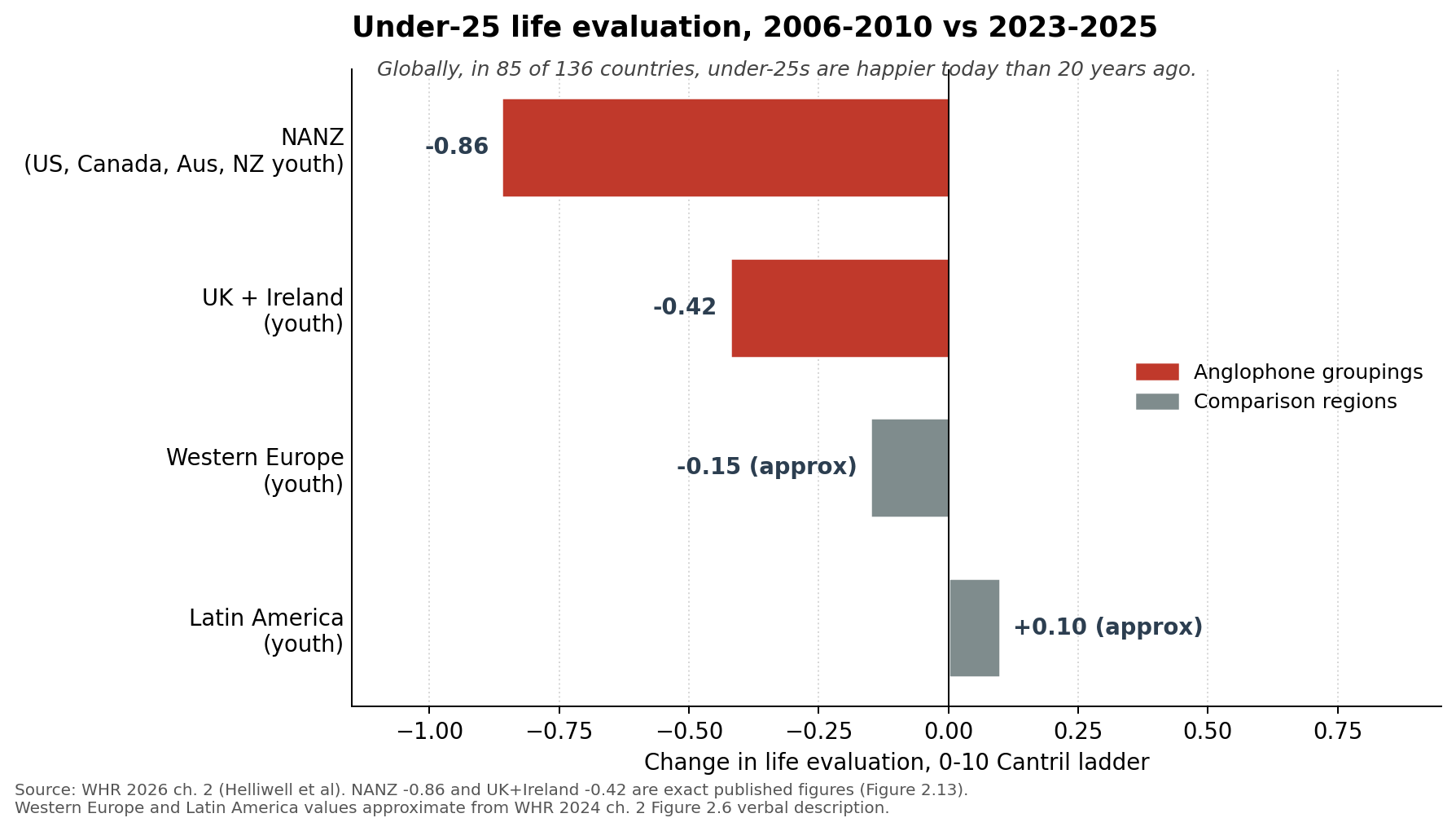
On what -0.86 means:
The metric used is called the Cantril ladder. The Gallup interviewer asks: "Imagine a ladder with steps numbered 0 at the bottom to 10 at the top. The top represents the best possible life for you. The bottom represents the worst possible life for you. Where do you stand today?" The numbers presented are the country averages of this scale.
To calibrate what 0.86 points actually means:
- Finland is the highest at ~7.7 compared to Afghanistan which scored ~1.4 (the unhappiest). So the full spread is about 6.3 points.
- Within the rich-country range, 0.86 points is roughly the gap between Norway (~7.3) and Italy (~6.4). That's a Nordic to Mediterranean level drop in reported happiness in only 15 years.
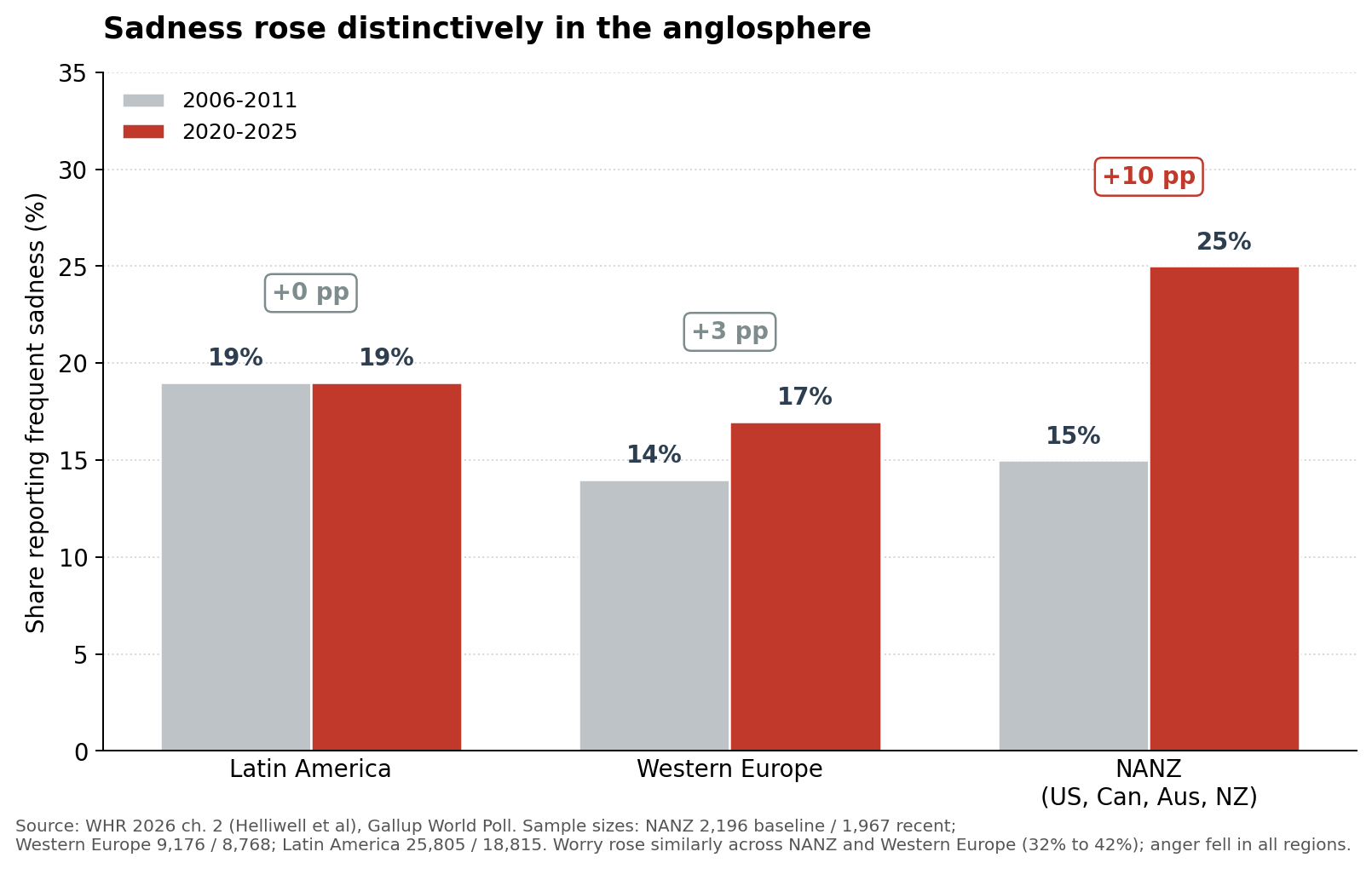
The UK and Ireland together lost 0.42 points over the same period, so all 6 of the major English-speaking countries studied (US, UK, Canada, Ireland, Australia, New Zealand) have seen substantial drops in happiness. For comparison, globally, in 85 of 136 countries, under-25s are happier today than 20 years ago.
Helliwell, founding editor of the World Happiness Report, describes the observed drop: "I have never seen such an extreme change. This has all happened in the last 10 years, and it's mainly in the English-language countries. There isn't this drop in the world as a whole."
The natural question is, what is going on with the English speaking countries? One plausible hypothesis is simply the purchasing of smart phones early, and rapid adoption of social media. This has been shown elsewhere to have significant impacts on people's loneliness and mental health.
The 2025 World Happiness Report found that if Quebec were ranked separately from the rest of Canada, it would come 6th out of 147 countries. Canada at large ranks 18th. The under-25 happiness slide that hit the rest of Canada is dramatically smaller in Quebec, across multiple metrics from the Canadian Happiness Report 2024 (McCanny et al, University of Toronto). Anglophones living inside Quebec track the rest-of-Canada anglophone average more closely than they track their francophone neighbours.
This experiment very cleanly separates many confounding factors such as governance, approach to lockdowns, economic circumstances, education, and social media access. It seems there genuinely is something specific about the use of English. Helliwell's interpretation, given to Global News in December 2025: "It isn't just access to social media and internet use. It's how it's used and what you hear and see on it, and what kind of linkages you get to others through it."
Other explanations such as quebec's cheaper tuition and better access to daycare also don't seem like good explanations, considering they have existed for decades, and thus don't match the sudden decline in 2010.
Leave a comment
Comments are public and appear once reviewed. No email address is collected.
Questions, thoughts?
No comments yet. Be the first to leave one below.