2 April 2026
How did the United States hand over its future to corporations?
Day 1 of Inkhaven: 30 Days of Posts
Recently, upon arriving at San Francisco airport, I felt a bittersweet feeling driving through to my destination. On the one hand, the extraordinary things the US has built are obvious, but at the same time people seem to obviously be struggling. People seem unwell, and dozens of shops seem to be decaying or closing. There is a sense of living in the hollow shell of extraordinary past success. I was stuck with the question: how can the US be so rich and yet driving through SF things look like they're falling apart?
This was illustrated by my uber driver mentioning that despite him earning 100k USD per year, he has almost nothing left over at the end of the year. He lives a basic life with a small family, and works extremely hard to support them. Monthly expenses come to 6-8k per month. Coming from London, while people there complain about issues, they generally seem much less close to the edge, and much more comfortable with their circumstances.
The US seems to have developed a deep mistrust of public spending, and has forgotten the fact that it was enormous public spending that built its enormous economic strength.
From 1945 to 1975, the United States poured money into universities and public works projects, with the GI bill providing money to send the young men returning from war to go to university. This was coupled with strong unions, regulated finance, and a tax rate of 70-91% on the highest earners. This all stemmed from observing the failures of the Great Depression and how this kind of government spending was able to fill gaps that private business simply had no incentive to fill.
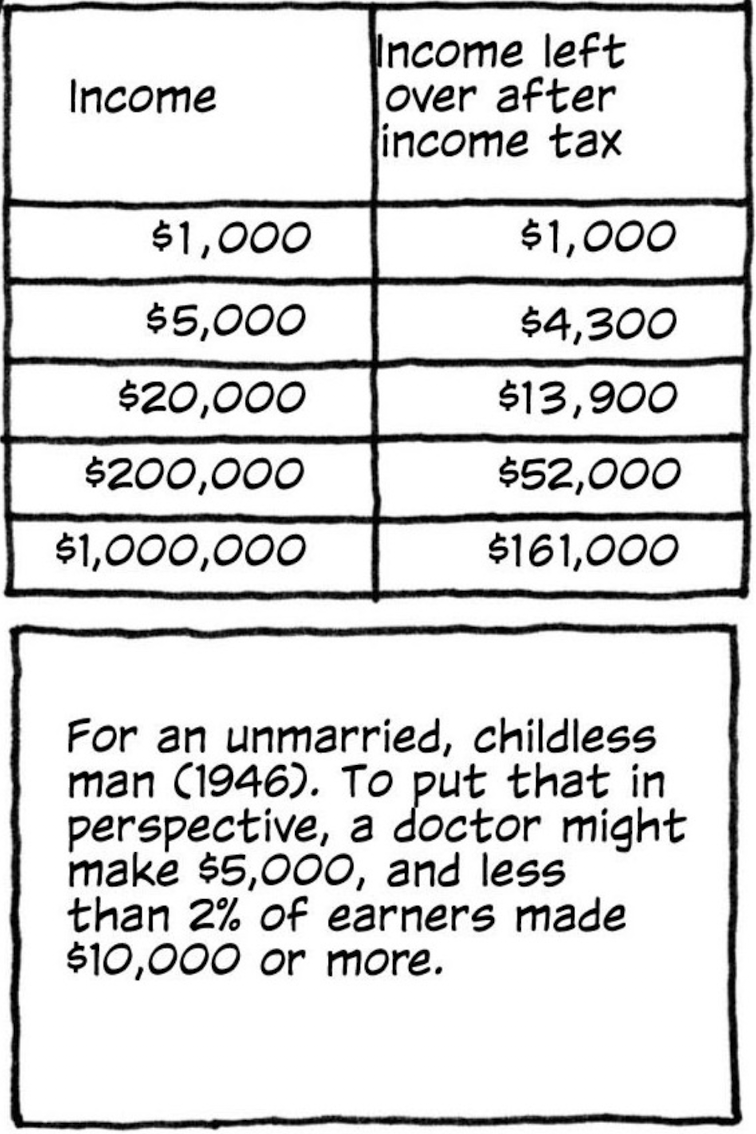
Corporate CEOs had very little reason to take enormous salaries because the amount they would take home would get massively cut into. This pressure, along with public programs to keep the unemployed productive and making it straightforward for young Americans to get access to university educations led to the development of the largest middle class of any country in history.
The tragedy is that the United States walked away from the model that made it so successful in the first place. The specific trajectory of what happened are well documented public facts, but the story is horrific in how deliberate it was.
In the 1970s, consumer protections in the US were rolling in, with legislation such as the Clean Air Act, Clean Water Act, new worker safety rules and other laws designed to protect consumers, workers and the environment from rampant exploitation by corporations.
Lewis Powell was a corporate lawyer who sat on the boards of 11 different companies. He'd spent years fighting scientific evidence linking smoking to cancer on behalf of Philip Morris. He understood that evidence-based regulation was a threat to his clients, not to the American economy.
In 1971 Powell drafted a memo titled "Attack on American Free Enterprise System." which was delivered to the chamber of commerce, and made the argument that the entire US economy was under existential threat from these new regulations, when in reality he was likely aware that it represented only minor constrictions to corporate profits. The narrative was existential in nature, and was not meant to be seen by the public, only being unearthed by a columnist at the Washington Post a year later. By this time Powell had already been elevated to the Supreme Court.
The memo laid out a detailed strategy for how corporations could take over institutions in the US and use them to shape incentives to their benefit, using universities, legal groups, media, courts, think tanks, political organisations and lobby groups to further their interests and arrest the course of regulation in the US, and to build structures that would work to their benefit.
The impact was dramatic. There were 176 companies with lobbying offices in Washington in 1971, and 2,445 by 1982. With them the number of lobbyists exploded to 9,000 lobbyists and 60,000 trade association employees, an entire industry dedicated to serving corporate interests. Think tanks such as the Heritage Foundation (1973) and the Cato Institute (1977) were established to promote free market ideology and supply policymakers with arguments for deregulation and tax cuts. The Chamber of Commerce went from 60,000 to 250,000 member firms.
This industry led to an entire new media pipeline, and the establishment of a new worldview in the US, focused on small government, trickle down economics, and tax cuts for the very wealthy. This culminated with Ronald Reagan as a political candidate who would implement the most dramatic tax cuts in American history.
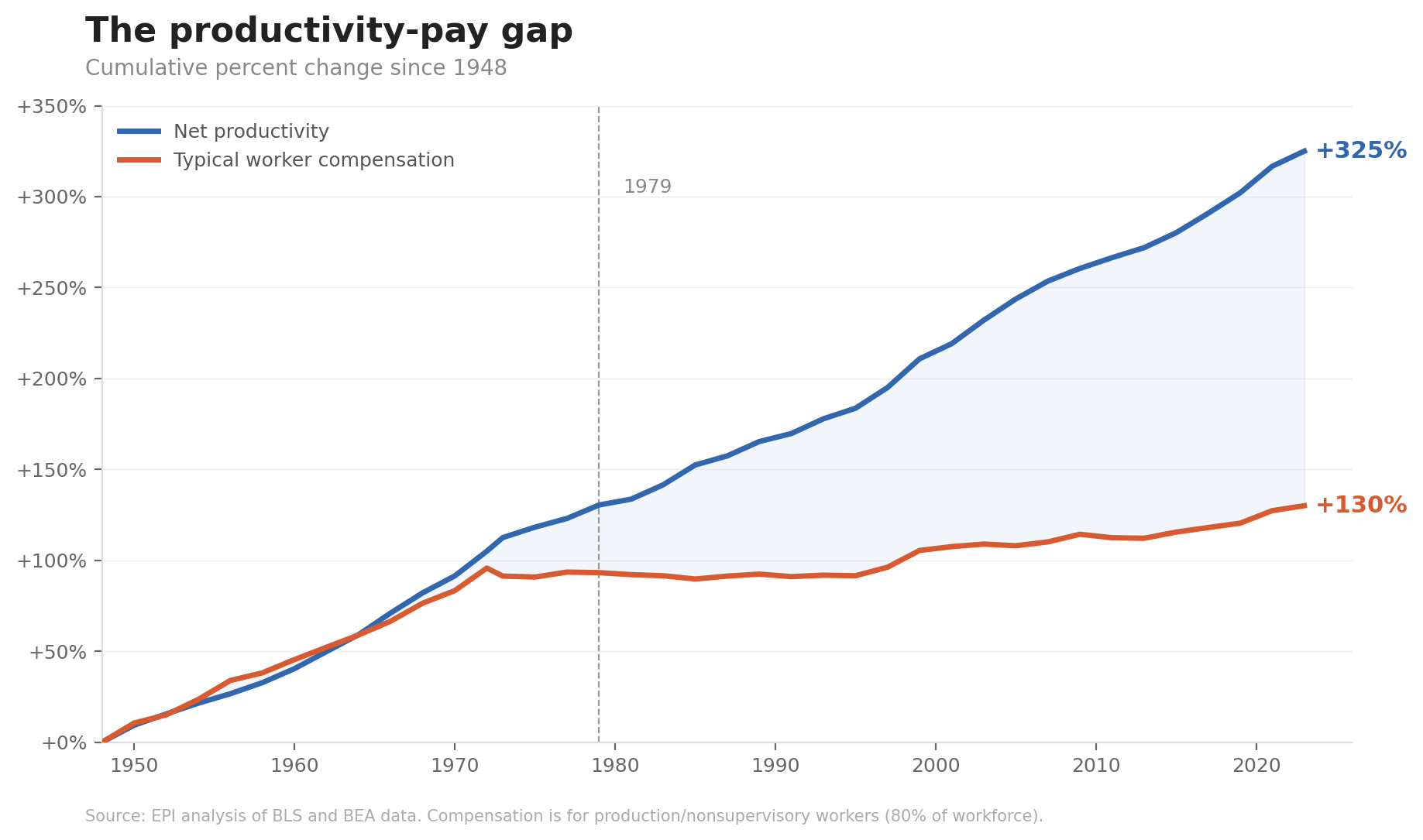
The impact of these changes can be seen in the chart above. While the divergence starts in the 1970s with the Vietnam War, exploding oil prices and Richard Nixon introducing wage and price controls, the divergence was locked in by the intentional dismantling of worker protections and limits placed on public spending.
The top marginal income tax rate went from 70% in 1980 to 50% in 1981 (Economic Recovery Tax Act), then down to 28% by 1986 (Tax Reform Act). The corporate tax rate went from 46% to 34% over the same period. Capital gains tax was cut from 28% to 20%. This was the systematic gutting of one of the most important drivers of shared prosperity over the previous 30 years, and yet that very driver was deliberately miscast as the thing that caused the economic slowdowns of the 1970s. Even the name "Economic Recovery Tax Act" illustrates the narrative they were manufacturing.
Arguably what most vindicates America's old policies is that the leading Asian powers have happily implemented this approach of massive public spending, though through a slightly different mechanism. While tax rates in South Korea reached 70% in the 1970s, the primary mechanism was enormous state investment in public education, industry and infrastructure. Today the highest tax rates have come down in these countries to 55% in Japan, and 45% in South Korea and China, while in the US it has dropped to 37%.
Considering the actual tax percentages are not wildly different, how do the Asian economies afford to pour money into industry and education? The answer lies in where the money goes: military spending absorbs 3.5% of GDP and healthcare takes an extraordinary 17% (together over a fifth of the entire economy), roughly double what peer countries spend on healthcare, while achieving significantly worse outcomes.
While these countries are still behind the US in many areas, the pace at which they have matched or exceeded the US on many aspects of public wellbeing is cause for consideration.
Leave a comment
Comments are public and appear once reviewed. No email address is collected.
Questions, thoughts?
No comments yet. Be the first to leave one below.